
Exosome vs PRP for Hair Loss in 2026: Which One Actually Works?
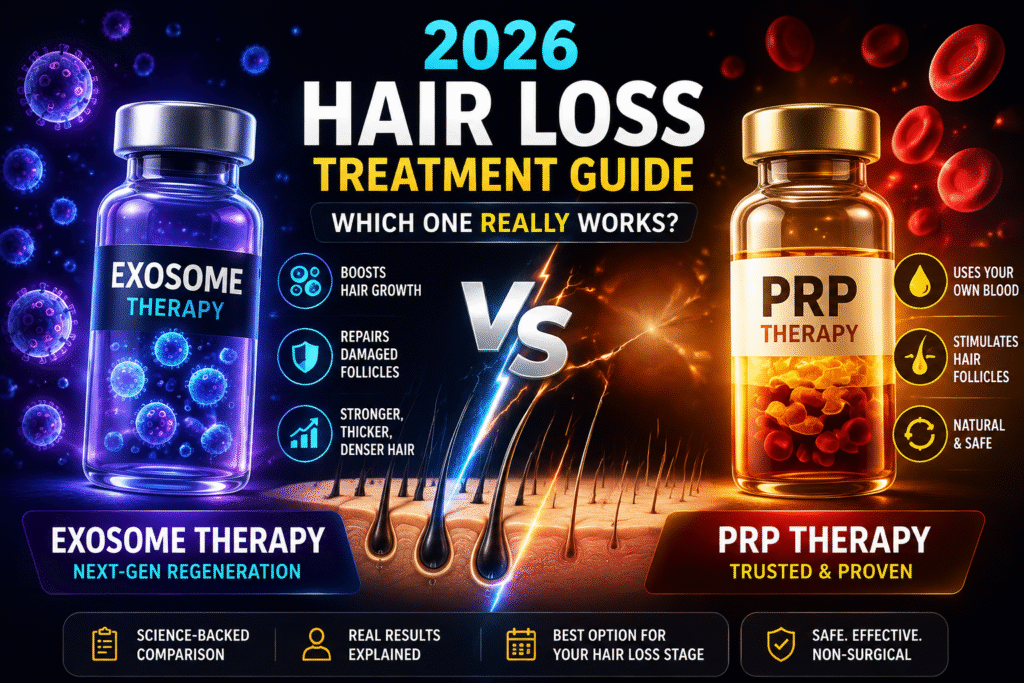
In 2026, the battle against hair loss has entered a new era. Two advanced regenerative treatments are dominating the conversation among patients and specialists alike: Exosome Therapy and PRP (Platelet-Rich Plasma). The growing debate of Exosome vs PRP for hair loss has raised an important question — which treatment offers better results for hair regrowth? Both therapies aim to restore thinning hair without surgery, but they work differently. We compare the science, effectiveness, real-world outcomes, and help you understand whether Exosome Therapy or PRP is the right choice for your specific hair loss stage.
💉 What Is PRP (Platelet-Rich Plasma) Hair Treatment?
PRP has been the gold standard in non-surgical hair restoration for over 15 years. The procedure uses your own blood’s healing power to stimulate dormant hair follicles and reverse the early stages of androgenetic alopecia (pattern hair loss).
How Does PRP Work on Hair Follicles?
PRP works through a simple but powerful biological process. When concentrated platelets are injected into the scalp, they release a cascade of autologous growth factors — including PDGF, VEGF, and IGF — that directly signal hair follicle cells to enter the active growth (anagen) phase.
①
Blood Draw
A small sample (20–30ml) of your own blood is taken from your arm.
②
Centrifuge
Blood is spun at high speed to isolate the platelet-rich plasma layer.
③
Scalp Injection
Concentrated PRP is precisely injected into thinning areas of the scalp.
How Many PRP Sessions Do You Need?
Most patients require 3–6 initial sessions spaced 4–6 weeks apart, followed by maintenance sessions every 4–6 months. Results vary depending on age, hair loss stage, and platelet concentration quality — which is why PRP is often combined with FUE hair transplant for maximum graft survival.
📌 Important: PRP effectiveness is age-dependent. Patients over 55 may have lower platelet quality, which can reduce treatment potency. This is one reason exosome therapy is gaining ground as an alternative.
🧬 What Is Exosome Therapy for Hair Loss?
Exosome therapy is the most exciting breakthrough in hair restoration in 2026. Unlike PRP, exosomes do not come from your own blood — they are lab-derived extracellular vesicles harvested from mesenchymal stem cells (MSCs), typically from umbilical cord or adipose tissue donors.
How Exosomes Stimulate Dormant Follicles
Exosomes act as the body’s “biological messaging system.” These nano-sized vesicles carry a payload of growth factors, proteins, mRNA, and microRNA directly into hair follicle cells — essentially instructing dormant follicles to reactivate. Think of them as “PRP supercharged with a software update” — delivering standardized, lab-controlled biological signals rather than relying on the patient’s own (age-variable) platelet quality.
MSC-Derived Exosomes: What Makes Them Different?
MSC (Mesenchymal Stem Cell)-derived exosomes represent the highest quality category of exosome products. Because they are lab-standardized, every dose contains a consistent concentration of bioactive molecules — unlike PRP, where potency can vary based on the patient’s health, age, and blood quality.
🔬 2026 Science Update: A growing body of clinical evidence shows MSC-derived exosomes can increase hair density by 20–40% over 6 months in patients with early-to-moderate androgenetic alopecia.
⚖️ Exosome vs PRP — Head-to-Head Comparison (2026)
Here is a complete side-by-side breakdown of every important factor that matters to real patients in 2026:
| Factor | 💉 PRP Therapy | 🧬 Exosome Therapy |
|---|---|---|
| Source | Patient’s own blood (autologous) | Lab-derived MSC stem cells ✅ Standardized |
| Blood Draw Required? | Yes — 20–30ml blood needed | No blood draw needed ✅ Easier |
| Treatment Time | 60–90 minutes per session | 30–45 minutes per session ✅ Faster |
| Sessions Required | 3–6 initial + maintenance | 2–4 sessions (higher potency) |
| Downtime | Minimal (24–48 hrs) ✅ | Minimal (24–48 hrs) ✅ |
| Potency / Consistency | Variable (depends on patient age/health) | Lab-standardized, consistent ✅ More Potent |
| Clinical Evidence | 15+ years, extensive studies ✅ Gold Standard | Growing evidence (2022–2026) |
| FDA Status | Well-established use ✅ | Not FDA-approved (investigational) |
| Best For | Early-moderate hair loss, post-transplant | Early-moderate, any age, age-related loss |
| Avg. Cost Per Session | $400–$800 ✅ More Affordable | $1,200–$2,500 |
| Trending in 2026? | Stable ↔ | 🔥 Rapidly Rising ↑ HOT |
📊 Which Treatment Works Better? Clinical Evidence 2026
PRP Clinical Evidence
PRP has the most robust clinical backing of any non-surgical hair treatment. Multiple double-blind, randomized controlled trials confirm that PRP injections significantly increase hair density, shaft diameter, and growth rate in patients with androgenetic alopecia. The consensus: PRP works — especially for early-stage hair loss in healthy individuals aged 25–50.
📈 PRP Results: Studies show an average 28–32% increase in hair density after 3 sessions, with peak results at 6 months. Results last 12–18 months before maintenance is needed.
Exosome Clinical Evidence
Exosome therapy is still in its clinical adolescence, but 2025–2026 research is highly promising. Early trials using MSC-derived exosomes show superior results per session compared to PRP, particularly in older patients (50+) where PRP potency naturally declines due to reduced platelet quality.
🧪 Exosome Results: Preliminary studies report a 35–42% increase in hair density in early-stage alopecia patients after just 2–3 sessions. However, long-term (5+ year) data is still being collected.
🔗 Can You Combine Exosome and PRP Therapy?
Yes — and in 2026, the most progressive hair restoration clinics are doing exactly this. The “Hybrid Protocol” combines the established growth factor delivery of PRP with the advanced cellular signaling of exosomes, creating a synergistic treatment that outperforms either alone.
💡 The 2026 Hybrid Protocol: Leading clinics now offer a combined approach: Exosome therapy (Session 1) → PRP (Session 2–4) → Maintenance Exosomes. This protocol leverages exosome’s potent signaling in the critical initial phase, then uses cost-effective PRP for ongoing maintenance.
👤 Who Is the Best Candidate for Each Treatment?
Choose PRP If You Are:
- Under 50 with healthy blood and good platelet quality
- In the early stages of hair thinning (Norwood 1–3)
- On a tighter budget and need multiple affordable sessions
- Looking for a proven, well-documented treatment with 15+ years of data
- Recently had a FUE or DHI transplant and want to improve graft survival
Choose Exosome Therapy If You Are:
- Over 50 where platelet quality may be reduced
- Needle-averse and want to avoid blood draws
- Looking for faster, more potent results with fewer sessions
- Willing to invest more for a cutting-edge treatment
- Experiencing postpartum hair loss or stress-related diffuse thinning
💰 Cost Comparison: PRP vs Exosome Therapy in 2026
| Cost Factor | 💉 PRP | 🧬 Exosome |
|---|---|---|
| Per Session | $400 – $800 | $1,200 – $2,500 |
| Full Initial Course | $1,500 – $4,000 | $2,400 – $7,500 |
| Annual Maintenance | $800 – $1,600 | $1,200 – $2,500 |
| Total 2-Year Cost | $2,300 – $5,600 ✅ More Affordable | $3,600 – $10,000 |
| Turkey / Medical Tourism | $300 – $500/session ✅ Best Value | $700 – $1,500/session |
❓ Frequently Asked Questions
Does exosome therapy actually regrow hair?
Yes, but with realistic expectations. Exosome therapy can “reawaken” dormant follicles and significantly increase hair density in early-to-moderate stages of hair loss. Clinical studies in 2025–2026 show impressive results, but exosomes cannot revive completely dead follicles. Early intervention yields the best outcomes.
Is exosome therapy better than PRP for hair loss?
In terms of potency per session, exosome therapy is generally considered more powerful than PRP — especially for older patients. However, PRP has significantly more long-term clinical data. Many experts now recommend the Hybrid Protocol combining both treatments.
Is exosome hair therapy FDA approved in 2026?
No. As of 2026, exosome therapy for hair loss is not FDA-approved and is considered investigational. However, it is legally offered in many countries including Turkey, South Korea, and the UAE. Always choose clinics with lab-certified, quality-sourced exosome products and qualified medical practitioners.
Can you combine PRP and exosome therapy together?
Absolutely. The 2026 Hybrid Protocol is becoming a standard offering at leading hair restoration clinics. Combining exosomes (for potent initial signaling) with PRP (for cost-effective maintenance) delivers synergistic results that outperform either treatment alone.
How long does it take to see results from exosome hair therapy?
Most patients notice reduced shedding within 4–6 weeks and visible new hair growth within 3–4 months of the first session. Peak density improvement is typically seen at the 6–9 month mark after the initial treatment course.
Does PRP or exosome therapy hurt?
Both treatments use topical numbing cream or local anaesthesia before scalp injections. Most patients report only mild discomfort, similar to a light scalp pressure. Pain levels are generally rated 2–3 out of 10. Post-treatment sensitivity typically resolves within 24–48 hours.
Is PRP or exosomes better for post hair transplant recovery?
Both are effective post-transplant, but exosome therapy is gaining preference in 2026 for its superior anti-inflammatory properties and faster graft stabilization. PRP (Platelet-Rich Plasma) remains a cost-effective and proven option. Many surgeons apply PRP during the FUE procedure itself and then recommend exosome therapy 4–6 weeks post-op.
What are the side effects of exosome scalp treatment?
Side effects are generally mild and temporary: redness, mild swelling, and tenderness at injection sites lasting 24–72 hours. Because exosomes are from donor cells (not your own blood), there is a theoretical risk of immune reaction — though this is extremely rare with properly lab-certified products. Always verify your clinic’s exosome sourcing credentials.
🏆 2026 Verdict: Which One Wins?
For most patients, PRP remains the smarter starting point — it’s affordable, proven, and effective. However, if you’re over 50, want faster results, or need fewer sessions, Exosome therapy is the superior biological investment. The ultimate winner? The Hybrid Protocol that combines both for maximum regenerative impact.
Ready to find out which treatment is right for you? Book a free consultation with our specialists today and get a personalized hair restoration plan based on your unique hair loss stage.