
Corticosteroids for Hair Loss: When Cortisone Really Helps
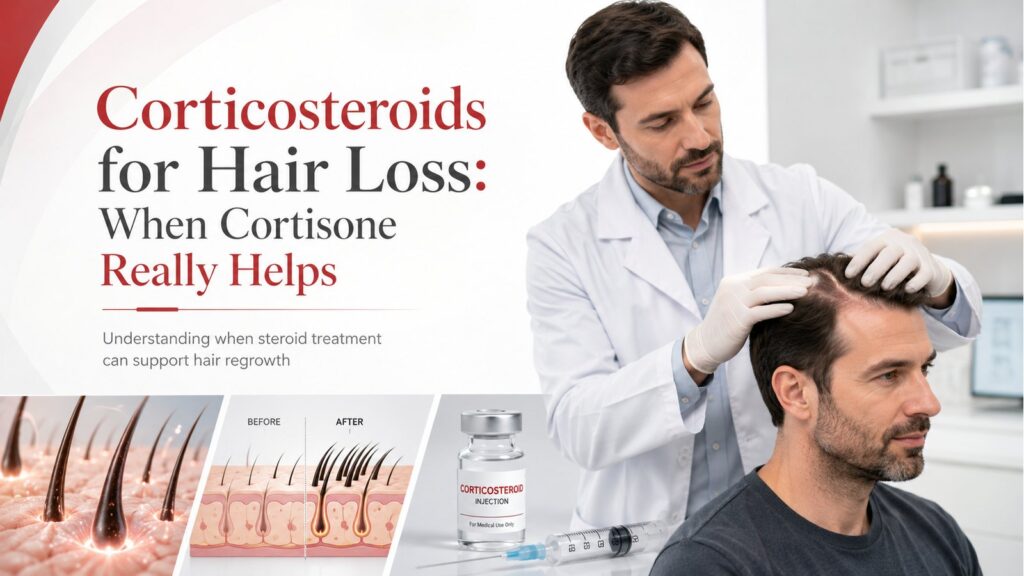
Editorial note: This educational article is published by Beauty Up Aesthetics for patient awareness. It does not replace an in-person diagnosis or prescription by a qualified clinician.
Corticosteroids for Hair Loss: When Cortisone Really Helps
Hair loss is not one single condition. It can result from genetics, autoimmune inflammation, hormonal changes, nutritional deficiency, thyroid disease, stress, medication, infection or permanent scarring of the follicles. That is why a treatment that works well for one person can be ineffective—or inappropriate—for another. Corticosteroids, often called “cortisone” or simply “steroids,” are a good example. They can be highly useful when inflammation is attacking otherwise viable hair follicles, but they are not a universal hair-growth treatment.
The best-known role for corticosteroids is in alopecia areata, an autoimmune condition that commonly causes smooth, round or oval patches of sudden hair loss. Depending on the diagnosis, a specialist may prescribe a topical corticosteroid, inject a small amount into active patches, or occasionally use a short systemic course. The objective is not to “feed” the hair. It is to suppress the abnormal inflammatory response around the follicle so that the follicle has a chance to restart growth.
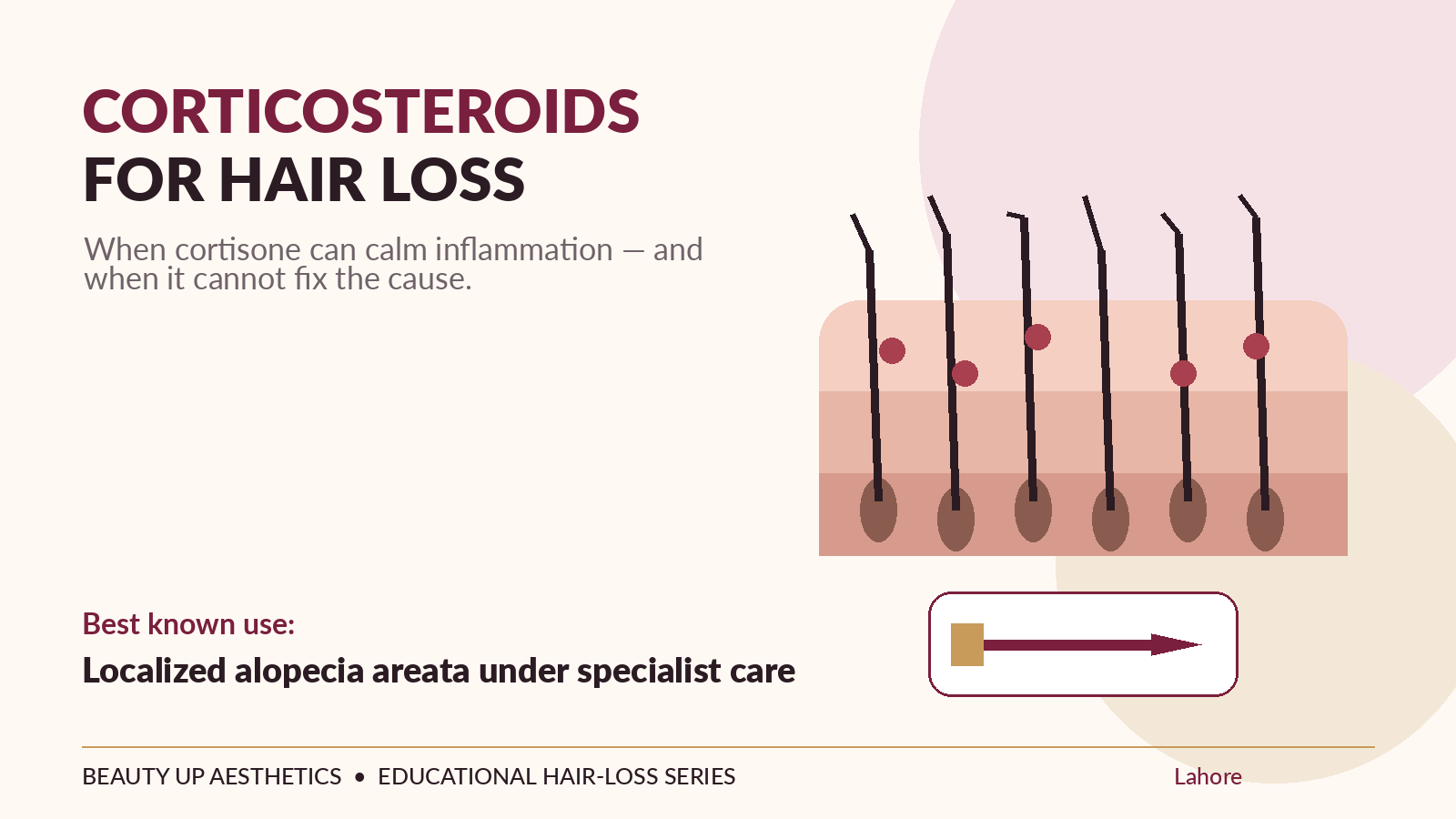
What are corticosteroids, and how can they affect hair growth?
Corticosteroids are anti-inflammatory medicines related to hormones naturally produced by the adrenal glands. They are different from anabolic steroids used to build muscle. In inflammatory hair disorders, immune cells and chemical signals gather around the follicle. The follicle may enter a resting phase, produce weaker hair or stop producing visible hair altogether. By reducing this inflammation, corticosteroids may allow a non-scarred follicle to resume activity.
This distinction matters: corticosteroids do not create new follicles, correct a vitamin deficiency or reverse hereditary sensitivity to androgens. They work best when the principal therapeutic target is inflammation. Before treatment, a clinician may examine the scalp with dermoscopy, review the pattern and speed of loss, ask about symptoms such as itching or burning, and order blood tests or a scalp biopsy when the diagnosis is uncertain.
When does cortisone really help hair loss?
1. Localized alopecia areata
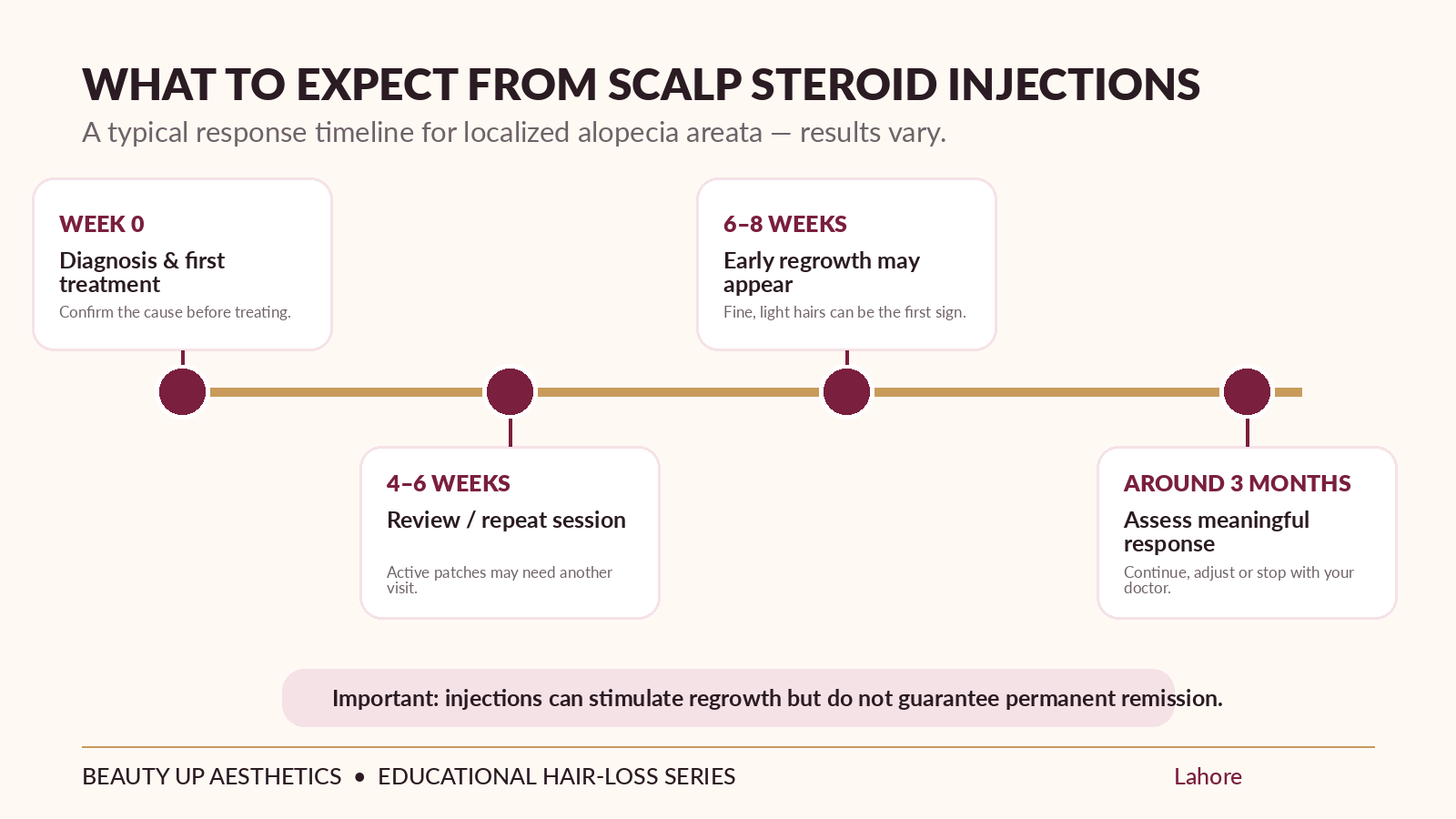
For adults with a small number of patchy alopecia areata spots, intralesional corticosteroid injections are among the most established options. A very fine needle places medicine into the affected skin rather than throughout the whole body. Sessions are commonly spaced several weeks apart. When treatment is effective, early regrowth may become visible within weeks, while a clearer response is often assessed over approximately three months.
These injections can be used on selected scalp, beard or eyebrow patches. However, they do not prevent a new patch from appearing elsewhere and they do not permanently “cure” alopecia areata. The condition is unpredictable: some people experience long remission, some relapse, and some have spontaneous regrowth even without treatment. The decision to treat depends on age, location, extent, duration, activity and the emotional impact of the hair loss.
2. Alopecia areata in children or injection-sensitive patients
Potent topical corticosteroids may be considered when injections are unsuitable, particularly in children. They can be supplied as solutions, lotions, foams, creams or ointments depending on the site and hair density. Treatment must be supervised because stronger products, large treatment areas and prolonged use increase the risk of skin thinning and other adverse effects.
3. Some inflammatory or scarring alopecias
Corticosteroids may also form part of the treatment plan for inflammatory scarring disorders such as central centrifugal cicatricial alopecia, frontal fibrosing alopecia or lichen planopilaris. In these conditions, the priority is often to reduce symptoms and stop or slow further follicle destruction. Once a follicle has been replaced by scar tissue, reliable regrowth is unlikely; therefore, early diagnosis is important. Treatment may involve topical medication, targeted injections and other prescription drugs rather than corticosteroids alone.
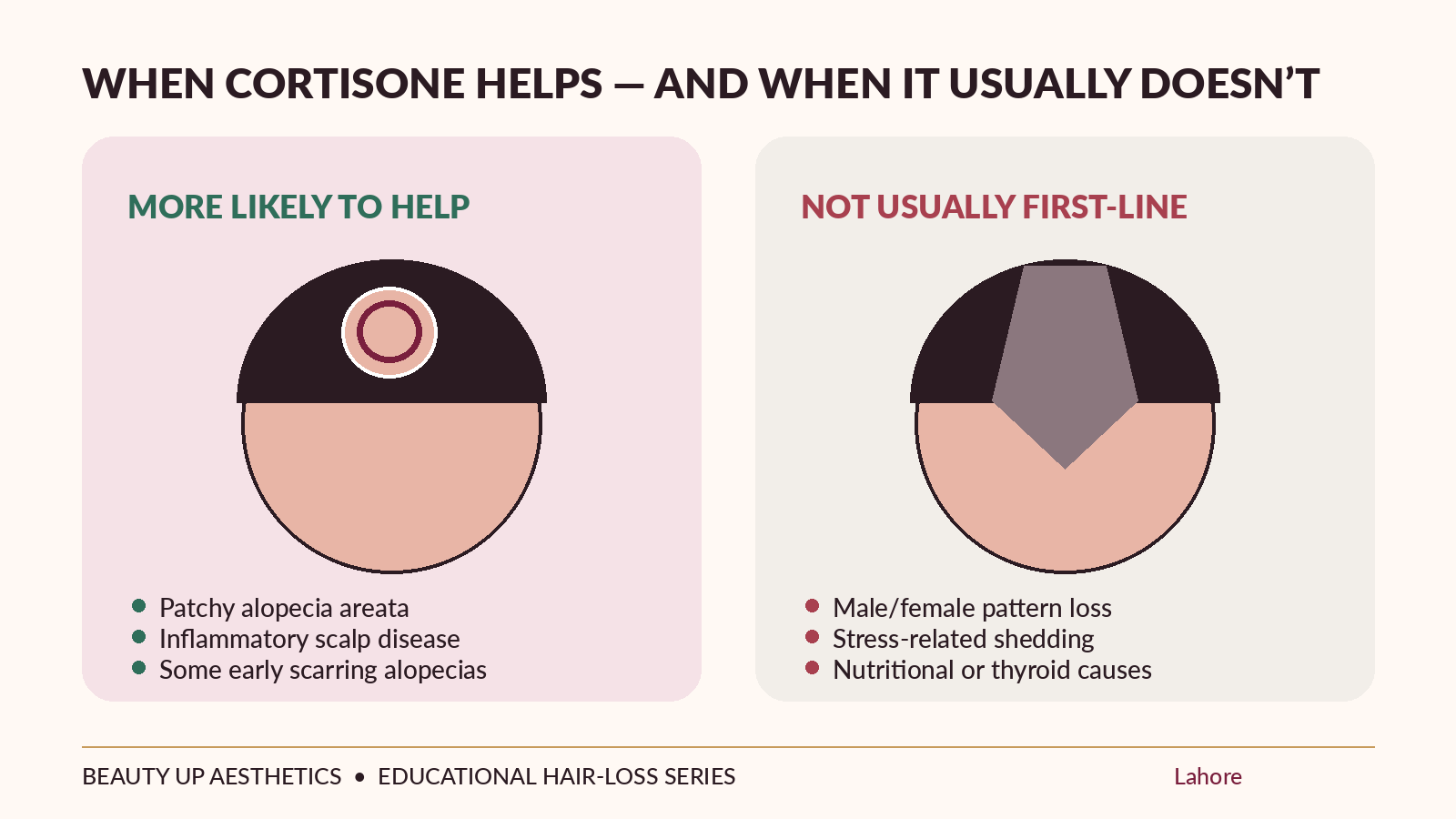
When are corticosteroids usually not the right answer?
Male and female pattern hair loss: Androgenetic alopecia is driven mainly by genetics and follicular sensitivity to hormones. Corticosteroids are not a routine stand-alone treatment. Evidence-based plans may instead involve minoxidil, selected prescription medicines, PRP-based treatment for suitable candidates, or hair transplantation when loss is stable and the donor area is adequate.
Telogen effluvium: Diffuse shedding after fever, surgery, childbirth, rapid weight loss, severe stress or certain medicines is usually managed by identifying the trigger and allowing the hair cycle to recover. Steroid injections do not correct the underlying trigger.
Nutritional, thyroid or metabolic causes: Low iron stores, thyroid dysfunction and other medical issues need diagnosis and cause-specific treatment. Injecting cortisone into the scalp cannot replace iron, normalize thyroid hormones or correct inadequate protein intake.
Fungal infection: Tinea capitis requires antifungal treatment. Injecting a steroid into active infection can be unsafe. Any scaling, broken hairs, pus, tenderness or swollen lymph nodes should prompt medical assessment rather than cosmetic self-treatment.
Topical, injected or oral: what is the difference?
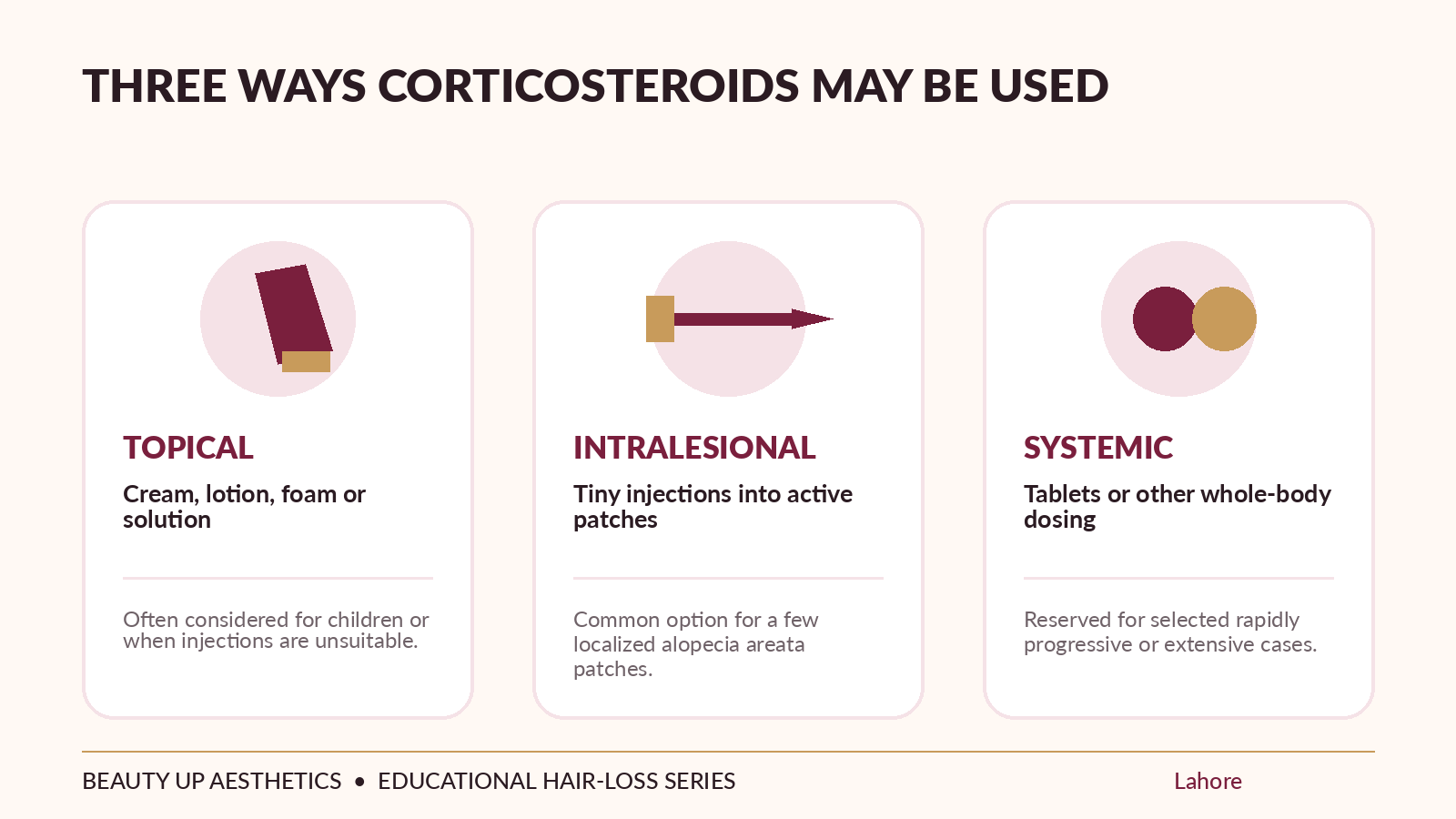
Topical corticosteroids act mainly in the skin where they are applied. They avoid needles but require consistent use and may be less effective in some adults with thicker scalp skin.
Intralesional corticosteroids deliver a small amount directly into active patches. This is the form people often mean by “cortisone shots for hair loss.” It provides a concentrated local anti-inflammatory effect while limiting whole-body exposure, although local adverse effects can occur.
Systemic corticosteroids affect the whole body and may produce regrowth in selected rapidly progressive or extensive cases. Because relapse can occur after stopping and systemic risks rise with dose and duration, they are generally reserved for carefully selected patients and short, specialist-directed regimens.
How long does it take to see hair regrowth?
Hair grows slowly, so the absence of visible change after a few days does not mean treatment has failed. With localized alopecia areata injections, early fine hairs may appear in roughly six to eight weeks in responders, and a more meaningful assessment is often possible around three months. The first hairs can be thin, pale or different in texture before becoming more normal. If repeated treatment produces no useful regrowth over several months, the clinician may stop, revise the diagnosis or discuss another strategy.
Possible side effects of cortisone treatment on the scalp
Scalp injections can cause brief pain, pinpoint bleeding, bruising, temporary tenderness or, rarely, infection. The most recognized local complication is skin atrophy—a small depression or “dent” where the skin becomes temporarily thin. Color change and visible small blood vessels may also occur. Correct injection depth, spacing and dose selection help reduce these risks.
Topical products can cause skin thinning, irritation, folliculitis or stretch-mark-like changes when misused. Systemic corticosteroids carry wider risks, including elevated blood sugar or blood pressure, mood and sleep changes, fluid retention, infection risk, weight gain and bone loss, especially with repeated or prolonged exposure. Patients who are pregnant, have diabetes, uncontrolled hypertension, active infection, stomach ulcer disease, glaucoma or other significant conditions should disclose their full medical history before treatment.
Corticosteroids versus PRP, minoxidil and hair transplant
These treatments are not interchangeable. Corticosteroids target inflammation. Minoxidil aims to support the hair-growth cycle and is commonly used for pattern thinning or to help maintain regrowth in selected cases. PRP, PRGF and related regenerative procedures may be considered for certain non-scarring thinning patterns, often as part of a broader plan. Hair transplantation relocates existing follicles and is primarily used for stable permanent loss with a suitable donor area; it does not treat active autoimmune inflammation.
A person with patchy alopecia areata may need anti-inflammatory treatment rather than a transplant. A person with hereditary thinning may need a long-term maintenance plan rather than repeated scalp steroid injections. This is why diagnosis should come before choosing a procedure.
What should happen during a specialist consultation?
A responsible hair-loss consultation should document when the shedding began, whether it is patchy or diffuse, family history, recent illness, pregnancy, weight change, stress, medicines, diet and scalp symptoms. Examination may include a hair-pull test and magnified scalp assessment. Blood tests or biopsy are used only when clinically indicated. Your clinician should explain the working diagnosis, realistic goals, treatment alternatives, expected timeline, cost, adverse effects and follow-up plan without guaranteeing regrowth.
At Beauty Up Aesthetics in Lahore, patients can book a hair and scalp consultation to discuss the cause of loss and whether medical treatment, PRP, PRGF or exosome-based hair restoration, or a hair-transplant assessment is appropriate. For patchy or rapidly progressive loss, a medical diagnosis should be established before any cosmetic procedure. Book a consultation in Lahore.
Frequently asked questions
Do cortisone shots work for hair loss?
They can work well for selected inflammatory hair disorders, especially a few localized alopecia areata patches. They usually do not treat the root cause of hereditary pattern baldness or stress-related diffuse shedding.
How many scalp steroid injections are needed?
The number and spacing depend on patch size, location, response and safety. Sessions are often several weeks apart. A clinician should stop or modify treatment when regrowth is complete, the condition changes or there is no meaningful response.
Is the regrowth permanent?
Not always. Corticosteroids can suppress inflammation and stimulate regrowth, but alopecia areata may relapse. Ongoing follow-up is important if new patches appear.
Can I use a steroid cream on my scalp without a prescription?
Self-treatment is not recommended. Potency, formulation, diagnosis and duration matter, and an incorrect product can delay treatment of infection or scarring alopecia.
Are steroid injections suitable for eyebrows or beard patches?
They may be considered for selected alopecia areata patches in these areas, but the skin is delicate and treatment must be performed by an experienced medical professional.
The bottom line
Corticosteroids are valuable hair-loss medicines when the problem is driven by inflammation and the follicles remain capable of growth. Their clearest role is localized alopecia areata, with additional use in selected inflammatory scarring alopecias. They are not a universal remedy for genetic thinning, nutritional deficiency, thyroid disease, infection or temporary stress shedding. The safest route to better results is a precise diagnosis, realistic expectations and a specialist-supervised plan.
Medical disclaimer: This article is for education only and does not provide a diagnosis or prescription. Treatment suitability, medicine selection and injection technique must be decided by a qualified clinician after examining the patient.
Medical references