
How Many Grafts Do You Need for a Hair Transplant? Hairline, Crown and Density Guide
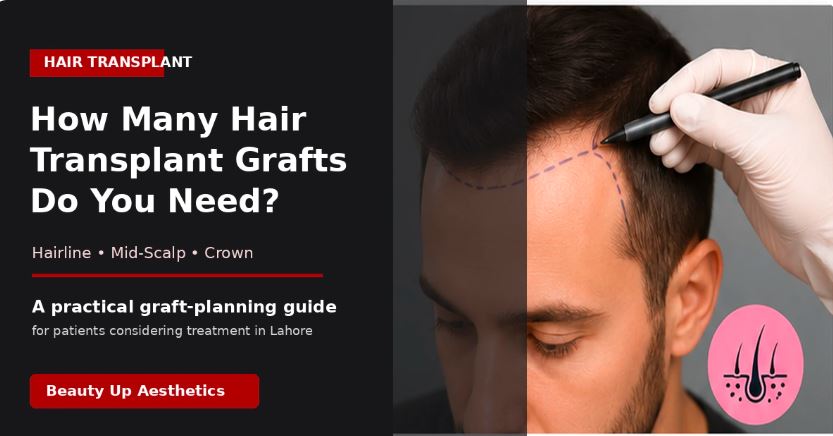

Editorial note: This article is for general education and does not replace a medical consultation. Individual suitability, graft numbers, treatment technique and expected outcomes must be assessed by a qualified clinician.
One of the first questions people ask before a hair transplant is simple: “How many grafts will I need?” The honest answer is that no fixed number works for everyone. For anyone researching a hair transplant in Lahore, a safe, natural-looking plan depends on the size of the thinning area, the strength of the donor zone, the patient’s hair characteristics, the desired hairline and the likelihood of future hair loss. That is why a responsible hair transplant consultation should focus on long-term planning—not merely the biggest number a clinic can quote.
This guide explains how graft estimates are made for the hairline, frontal area, mid-scalp and crown. It also compares FUE and DHI, explains the role of non-surgical options such as hair PRP, and shows why two people with a similar pattern of baldness may receive very different recommendations.

What Is a Graft in Hair Transplant Surgery?
A graft is a small naturally occurring follicular unit taken from the donor area, usually at the back and sides of the scalp. One graft may contain one, two, three or sometimes more hairs. For this reason, “2,000 grafts” does not automatically mean “2,000 hairs.” The visual result depends on the mix of follicular units, the thickness of each hair shaft, curl, colour contrast, placement angle and how the grafts are distributed.
In modern hair transplant planning, single-hair grafts are commonly reserved for the front edge of the hairline to create softness. Multi-hair grafts can be placed behind that edge to improve the appearance of density. This distribution is often more important than simply increasing the total graft count.
Why Hair Transplant Graft Numbers Vary
1. The size and shape of the thinning area
A narrow temple recession requires less coverage than a broad frontal zone. The crown may look like a small bald spot from the front, yet its circular shape can require a substantial number of grafts. A combined frontal and crown hair transplant therefore demands careful prioritisation, especially when donor supply is limited.
2. Donor-area density and safe harvesting
The donor area is finite. A high graft estimate is not useful if removing that number would leave visible thinning or reduce options for future procedures. The International Society of Hair Restoration Surgery describes the donor zone as the source of healthy follicles and emphasises that its capacity must be protected. Published practice guidelines also caution against visible donor depletion and describe roughly 2,500–3,000 grafts as an average optimum upper limit for a single session, while recognising that individual cases and techniques differ.
3. Hair calibre, curl and colour contrast
Coarser or naturally wavy hair often creates more visual coverage than very fine, straight hair. Low contrast between hair and scalp can also make density appear fuller. These differences explain why the same hair transplant graft count can produce a different cosmetic effect in two patients.
4. Hairline position and target density
A very low hairline increases the area that must be filled and may consume donor supply needed later. A mature, age-appropriate hairline can frame the face while using grafts more efficiently. The best hair transplant design balances current goals with how the patient may look five, ten or twenty years from now.
5. Ongoing native hair loss
Transplanted follicles and existing native hair are not the same thing. Native hair may continue to thin, so the surgeon must consider family history, age, the stability of hair loss and whether medical management is appropriate. A successful hair transplant plan should not create an isolated dense patch surrounded by progressive thinning.

Approximate Hair Transplant Graft Ranges
The following ranges are educational examples, not a quotation or treatment promise. A physical examination can move an estimate higher or lower. Hair-loss classifications such as the Norwood scale help describe the pattern, but they do not replace measurement of the recipient area and donor density.
| Typical treatment area | Illustrative graft range | Planning priority |
|---|---|---|
| Small temple or hairline refinement | Approximately 800–1,500 | Soft, natural edge and symmetry |
| Hairline plus frontal third | Approximately 1,500–2,500 | Face framing and density behind the hairline |
| Frontal area plus mid-scalp | Approximately 2,500–3,500 | Coverage, continuity and donor conservation |
| Crown or vertex only | Approximately 1,000–2,000+ | Whorl pattern, diameter and realistic density |
| Advanced combined loss | Approximately 3,500–5,000+ across one or staged sessions | Prioritisation and long-term donor strategy |
Research and clinical guidance show why these figures must stay flexible. A Norwood 2 patient may need around 1,000–1,500 grafts for a limited frontal correction, while advanced hair loss creates a mismatch between the large recipient area and the available donor supply. In some cases, the safest hair transplant strategy is to restore the frontal frame first and consider the crown later.
Hairline, Mid-Scalp or Crown: Which Area Comes First?
For many patients, the frontal hairline offers the greatest visual impact because it frames the face. When donor hair is limited, a surgeon may recommend concentrating the first hair transplant session on the hairline and frontal third rather than spreading grafts too thinly across the entire scalp.
The mid-scalp supports the transition from the front to the crown. It may not be the first area a patient notices, but poor continuity can make the result look disconnected. The crown is technically demanding because hairs naturally rotate in a whorl. It can also consume many grafts without appearing as dense as the frontal area. A staged hair transplant may therefore be more realistic for extensive loss.
FUE Lahore and DHI Lahore: Do Techniques Change the Graft Number?
FUE stands for Follicular Unit Extraction. Individual follicular units are extracted from the donor area and then placed into the recipient zone. DHI is commonly used to describe direct implantation with a specialised implanter after follicular-unit extraction. Sapphire FUE refers to the use of sapphire blades when recipient channels are created. These terms describe parts of the surgical workflow; none of them creates unlimited donor hair.
People comparing FUE Lahore and DHI Lahore options should ask how the recommended method fits their donor strength, thinning pattern, hairline design and density target. Technique can influence shaving requirements, workflow, implantation control and recovery experience, but the required graft number still depends primarily on recipient size and safe donor capacity.
A consultation for an FUE hair transplant or a DHI procedure should therefore explain why the method suits the individual patient rather than presenting FUE or DHI as a substitute for proper graft planning.
How to Choose a Good Hair Transplant in Lahore
Patients often search for the best hair transplant in Lahore, a good hair transplant in Lahore or a cheap hair transplant in Lahore. These phrases reflect real concerns about quality and affordability, but the safest decision should not be based on a promotional label or the lowest package price alone. Compare the clinician’s qualifications, who performs each surgical step, donor-area assessment, sterilisation standards, hairline design, documented results, aftercare and the clarity of the written treatment plan.
When a case requires assessment by a plastic surgeon in Lahore, verify the surgeon’s medical registration, relevant training and experience with the proposed procedure. A search for the best plastic surgeon in Lahore can help create a shortlist, but it is not proof of suitability. The consultation should explain benefits, limitations, possible complications, recovery and realistic outcomes for the individual patient.
Hair PRP, Hair Meso PRP and Hair Exosome Support
Not every patient needs surgery immediately. Hair PRP uses a patient’s own platelet concentrate as part of a clinician-led plan for selected thinning patterns or post-transplant support. Hair meso PRP may combine mesotherapy-style delivery with PRP or other clinician-selected scalp-support protocols. Hair exosome treatment is also marketed for regenerative support, although suitability, evidence, product quality and expected benefits should be discussed carefully with a qualified medical professional.
These treatments do not manufacture donor follicles and should not be presented as guaranteed substitutes for a hair transplant where permanent follicular loss has occurred. Beauty Up Aesthetics provides information on hair PRP, Meso PRP and exosome therapy for patients who need a personalised non-surgical or combined hair-restoration plan.
Related Aesthetic Treatments at Beauty Up Aesthetics
Some patients use the same consultation to discuss broader skin and facial concerns. Beauty Up Aesthetics also lists laser hair removal, Hydrafacial, Botox, filler treatments and facelift threads among its aesthetic services. These treatments address different goals and should not be mixed into a hair-loss plan unless the patient separately requests them and a qualified clinician confirms suitability. Keeping each service on a dedicated website page and Google Business Profile service entry also helps users find the correct treatment information without weakening the focus of the hair transplant article.
Questions to Ask Before Accepting a Graft Estimate
Before booking a hair transplant, ask which scalp zones are included in the estimate, how donor density was measured, who will perform the surgical steps, what density is planned per zone and whether a second procedure may be needed. Also ask how the proposed hairline accounts for age and future hair loss.
A transparent clinic should be able to explain why it recommends a particular number. It should also discuss trade-offs. For example, using more grafts in the crown may mean accepting a higher frontal hairline, lower density elsewhere or fewer grafts available later.
How Beauty Up Aesthetics Plans a Hair Transplant in Lahore
At Beauty Up Aesthetics, the planning process begins with a consultation that reviews the hair-loss pattern, donor area, scalp condition, medical history and cosmetic goals. The aim is to design a personalised hair transplant in Lahore that looks natural and respects the donor supply rather than relying on a one-size-fits-all package.
Patients can review the clinic’s hair transplant services in Lahore, detailed guide to hair transplant cost in Lahore and the hair transplant recovery timeline before their visit. These resources explain how technique, graft count, cost and aftercare fit into the complete treatment journey.
Frequently Asked Questions
Can a clinic calculate my hair transplant grafts from photographs?
Photographs can support an initial estimate, but they do not show donor density, hair calibre, scalp laxity, miniaturisation or the exact size of each thinning zone. A final hair transplant plan should be confirmed through a proper assessment.
Is a higher graft number always better?
No. A number that exceeds safe donor capacity can cause visible thinning and reduce future options. Strategic distribution, natural angles and graft survival are more important than a headline number.
Can 3,000 grafts cover the whole scalp?
It depends on the area, hair characteristics and desired density. For moderate loss, 3,000 grafts may provide meaningful frontal and mid-scalp coverage. For advanced loss, a hair transplant may need prioritisation or staged sessions rather than attempting dense full-scalp coverage at once.
How many hairs are in one graft?
A follicular unit may contain one to four hairs. The average mix varies by patient and donor zone, so the number of hairs is not simply equal to the number of grafts.
Will I need another hair transplant later?
Possibly. Existing hair can continue to thin, and some patients choose a second session for additional density or crown coverage. Long-term donor conservation is therefore part of good planning.
Is a cheap hair transplant in Lahore always a good choice?
Not necessarily. A lower price may be reasonable, but patients should confirm who performs the procedure, how the donor area is assessed, what aftercare is included and whether the graft estimate is medically appropriate. Cost should be considered alongside safety, experience and long-term donor preservation.
Which is better, FUE or DHI?
Neither technique is automatically best for every patient. FUE and DHI differ mainly in workflow and implantation approach. The better option depends on donor characteristics, treatment area, shaving preference, density goals and the clinician’s plan.
Can hair PRP or hair exosome treatment replace a transplant?
They may support selected thinning patterns or a post-procedure plan, but they cannot replace follicles in areas where permanent hair loss has occurred. A clinician should first diagnose the cause and stage of hair loss.
Book a Personalised Graft Assessment in Lahore
An online calculator can provide a rough idea, but it cannot replace a clinician’s examination. For a personalised hair transplant in Lahore graft estimate, book a consultation with Beauty Up Aesthetics at 12 B1/B2, Ghalib Market, Gulberg 3, Lahore. Call or WhatsApp +92 305 1119912, or use the consultation booking page.
Sources and further reading: International Society of Hair Restoration Surgery patient resources on FUE and donor-area planning; peer-reviewed hair transplant practice guidelines; and published reviews of the Norwood classification and advanced-grade hair restoration. This page should receive final clinical review before publication.