
Hair Transplant Recovery Timeline: What to Expect from Day 1 to Month 12
Hair Transplant Recovery Timeline: What to Expect from Day 1 to Month 12
A hair transplant can restore thinning areas, improve the appearance of the hairline, and help patients feel more confident. However, the transformation does not happen immediately. Understanding the hair transplant recovery timeline is important because the scalp may heal within a few weeks, while the transplanted follicles can take several months to produce visible, mature hair.
During the first two weeks, the priority is protecting the newly implanted grafts and allowing the donor and recipient areas to heal. After this early stage, the transplanted hairs may temporarily shed before new growth starts. Hair then becomes progressively longer, thicker, and more natural-looking over the following months.
According to NHS guidance, patients may need approximately one to two weeks away from work after a hair transplant. New hair commonly starts appearing after around four months, while the complete result may take approximately 10 to 18 months.
This guide explains the hair transplant recovery process from the first 24 hours to month 12, including washing, shedding, regrowth, aftercare precautions, and signs that may require medical attention.
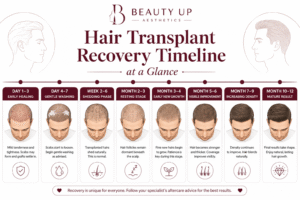
Hair Transplant Recovery Timeline at a Glance
Hair transplant recovery involves two different processes.
The first is the physical healing of the scalp. During this period, patients may experience mild tenderness, tightness, swelling, itching, redness, and small crusts around the transplanted hairs.
The second process is hair growth. Even after the scalp appears healed, the transplanted follicles may enter a temporary resting phase. The visible transplanted hairs can shed before the follicles begin producing new strands.
The exact recovery experience differs between patients. The number of grafts, hair texture, donor quality, scalp condition, age, medical history, smoking, treatment technique, and aftercare routine can all influence healing and growth.
Beauty Up Aesthetics provides different hair-restoration options in Lahore, including Micro FUE, Sapphire FUE, DHI, strip-method transplantation, women’s hair transplantation, and beard and eyebrow transplantation.
Your surgeon’s instructions should always take priority because recovery recommendations may vary according to the procedure and individual condition.
First 24 Hours After a Hair Transplant
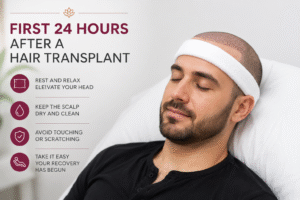
The first 24 hours are among the most delicate stages of the hair transplant recovery timeline. The implanted grafts have just been positioned, so the recipient area must be protected from rubbing, pressure, scratching, or accidental impact.
The scalp may feel mildly tender, tight, or numb. Small dots may be visible in the donor and recipient areas. Some patients may also experience mild swelling.
Patients are generally advised to rest and keep their head elevated while sleeping. Using extra pillows or a travel pillow can reduce accidental contact between the transplanted area and the bed.
Avoid bending forward, lifting heavy objects, exercising, or performing activities that increase sweating. Clothing that must be pulled tightly over the head should also be avoided. A loose button-front shirt is usually more practical during early recovery.
Do not apply hair oil, minoxidil, serum, styling products, herbal mixtures, or unapproved creams. Only use medication and scalp-care products recommended by the treating clinic.

Days 2 to 3: Swelling and Early Healing
During the second and third days, the scalp may remain sensitive. Small crusts can start forming around the implanted hairs, while the donor area may feel tight or itchy.
Some patients experience swelling across the forehead. This swelling may temporarily move toward the eyelids before gradually improving.
Bandages, when used, may be removed during the first few days. NHS guidance indicates that bandages can often be removed after approximately two to five days, although the exact timing depends on the procedure and the surgeon’s instructions.
Patients should continue avoiding rubbing, scratching, direct pressure, strenuous exercise, dust, heat, and excessive sunlight.
A person with a desk-based job may feel able to return to work within a few days. However, visible swelling, redness, or crusting may lead some patients to take additional time off.
Days 4 to 7: Gentle Washing Begins
Gentle washing is an important part of hair transplant aftercare. Many clinics allow patients to begin carefully washing the scalp during the first week, but the exact starting day should be confirmed by the treating surgeon.
The NHS states that patients may be able to wash their hair gently by hand around day six.
Use only the shampoo, lotion, or cleansing method recommended by the clinic. Avoid hot water, strong shower pressure, aggressive massage, and scratching with fingernails.
Shampoo should normally be applied softly rather than rubbed into the scalp. Water should be poured or allowed to flow gently over the treated area.
Do not forcefully remove crusts during the first wash. They should gradually soften and clear through the surgeon-approved washing routine.
The donor area often heals more quickly than the recipient area, but both areas still require gentle handling.
Days 8 to 14: Scabs Begin to Clear
By the end of the second week, tenderness and swelling usually improve significantly. Small crusts around the grafts begin loosening, and the scalp starts looking more normal.
Some redness, itching, or temporary numbness may remain. Redness can last longer in patients with sensitive skin.
Patients who undergo a strip-method or FUT procedure may require follow-up for stitch removal. Non-dissolvable stitches can commonly be removed after approximately 10 to 14 days.
Although the scalp may appear healed, patients should not automatically restart every activity. Swimming, intense exercise, helmets, hair colouring, chemical treatments, direct sunlight, and topical medicines should only be resumed after receiving approval from the clinical team.
Weeks 2 to 6: The Shedding Phase
Temporary shedding is one of the most misunderstood stages of the hair transplant recovery timeline.
A few weeks after surgery, many of the transplanted hair shafts begin to fall out. This can cause concern, but it does not necessarily mean the grafts have failed.
The visible hair shaft may shed while the transplanted follicle remains under the skin. The follicle then enters a resting period before producing a new strand.
The NHS notes that transplanted hairs often fall out after several weeks and later begin growing again.
Some non-transplanted hairs near the treated area may also temporarily shed due to the physical stress of surgery. This is sometimes referred to as shock loss.
Patients should avoid evaluating their final result during this phase. Contact the clinic if shedding is accompanied by worsening pain, severe inflammation, fever, spreading redness, or unusual discharge.
Months 2 to 3: The Resting Stage
During months two and three, the scalp may look fully healed, but visible growth may still be limited.
Some patients notice a few fine hairs, while others see little change. This period can be frustrating, but it is often a normal stage of the growth cycle.
The transplanted follicles do not all become active at the same time. Early growth may therefore appear uneven or patchy.
Existing non-transplanted hair may also continue thinning if the patient has progressive hereditary hair loss. A hair transplant moves follicles into thinning areas, but it does not automatically stop future loss in untreated hair.
Depending on the diagnosis, the clinician may discuss medical or non-surgical maintenance treatments after the scalp has recovered.
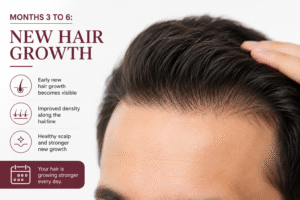
Months 3 to 4: Early New Hair Growth
New hair commonly starts becoming visible during the third or fourth month. The NHS reports that new transplanted hair usually begins appearing after approximately four months.
The first hairs may look thin, soft, lightly coloured, or slightly uneven in texture. This early growth does not represent the final density.
Some follicles may be producing hair while others remain in the resting stage. The hairline may therefore look incomplete during this period.
Patients should use photographs taken in similar lighting and from the same angles to monitor progress. Checking the mirror every day can make gradual improvement difficult to notice.

Months 5 to 6: Visible Improvement
Between months five and six, a larger number of follicles may enter the active growth phase.
The transplanted area begins looking fuller, and the hairline becomes easier to style. The new hair may still be finer than mature hair, but visible improvement is usually more noticeable.
The crown can take longer to develop density than the frontal hairline. Growth speed also differs according to individual biology, hair calibre, curl, donor quality, graft survival, scalp health, and aftercare.
A follow-up consultation can help the clinician assess the donor area, hair direction, scalp condition, and overall progress.
Months 7 to 9: Increasing Density and Maturity
During months seven to nine, transplanted hair generally becomes longer, stronger, and thicker.
Coverage improves as individual hairs gain calibre and begin overlapping. The transplanted area usually starts blending more naturally with surrounding hair.
Some newly growing hairs may initially appear slightly wavy, coarse, or different in texture. This can improve as the hair matures.
Patients can often style their hair more comfortably at this stage, although chemical treatments and specialised products should still be discussed with the clinical team.
Months 10 to 12: Mature Hair Transplant Results
By months 10 to 12, many patients can see a substantial cosmetic improvement.
The hairline looks more established, density becomes easier to assess, and transplanted hair can usually be cut and styled like natural hair.
However, month 12 is not an absolute deadline. The complete result may continue developing beyond one year, particularly when the crown has been treated.
NHS guidance states that full hair transplant results may take approximately 10 to 18 months.
Patients should attend their scheduled follow-up appointments instead of judging the result from online comparisons or edited advertisements.
FUE, DHI, Sapphire FUE, and FUT Recovery
The hair-growth timeline is broadly similar across FUE, DHI, Sapphire FUE, and FUT because transplanted follicles still pass through resting and growth phases.
The primary differences involve how follicles are harvested and how the donor area heals.
FUE removes follicular units individually from the donor area. FUT removes a narrow strip of donor scalp that is divided into individual grafts.
DHI uses an implantation device to place follicles, while Sapphire FUE involves sapphire-tipped instruments during channel creation.
The most appropriate method depends on the patient’s donor supply, hair-loss pattern, scalp characteristics, treatment goals, and medical assessment. Hair transplantation should be individually planned rather than selected only according to promotional claims.
Essential Hair Transplant Aftercare Tips
Correct aftercare helps protect the grafts and support scalp healing.
Follow the written instructions supplied by the clinic. Avoid rubbing or scratching the transplanted area, and use only approved shampoo and medication.
Strenuous exercise, swimming, steam rooms, direct sunlight, tight caps, helmets, smoking, and alcohol may be temporarily restricted.
Do not restart minoxidil, apply hair dye, use steroid creams, take antibiotics, or undergo PRP treatment without medical approval. The appropriate timing differs between patients.
Good hydration, balanced nutrition, proper sleep, and avoiding tobacco support general healing. However, no shampoo, oil, supplement, or home remedy can replace appropriate surgery and professional aftercare.
Warning Signs That Require Medical Attention
Mild redness, swelling, tenderness, crusting, itching, and temporary shedding may occur during normal recovery.
Contact the clinical team if you develop increasing pain, heavy or persistent bleeding, pus-like discharge, an unpleasant smell, fever, rapidly spreading redness, wound separation, or severe swelling.
Hair transplantation is a surgical procedure, and potential risks can include bleeding, infection, scarring, poor hair growth, and an unnatural-looking result.
Choosing an appropriately qualified clinician and attending follow-up appointments are essential. The International Society of Hair Restoration Surgery promotes medical standards, ethics, and patient safety within hair-restoration treatment.
Frequently Asked Questions
How long does hair transplant recovery take?
Visible scalp healing commonly occurs during the first one to two weeks. New hair usually starts appearing around four months, while complete results may require 10 to 18 months.
Is shedding after a hair transplant normal?
Yes. Transplanted hair shafts commonly shed after several weeks. The follicles usually remain under the scalp and can produce new hair after the resting stage.
When can I return to work?
Many patients return to desk-based work within several days. However, one to two weeks may be preferred because of redness, swelling, or visible crusting.
When can I wash my hair?
Gentle hand-washing may be permitted during the first week. The exact day, shampoo, and technique should be confirmed by the treating clinic.
When will the final result be visible?
Meaningful improvement is often visible between months six and twelve. Full maturation may continue for up to 18 months, particularly in the crown.
Hair Transplant Recovery Support in Lahore
A successful transplant involves more than completing the surgical procedure. Patients need realistic expectations, clear aftercare instructions, follow-up support, and a long-term strategy for protecting existing hair.
Beauty Up Aesthetics provides hair-restoration consultations and several hair transplant techniques in Lahore.
A consultation allows the clinical team to examine the donor area, assess the pattern of hair loss, review the patient’s medical history, and recommend an appropriate treatment and recovery plan.
To discuss your hair-restoration options, contact Beauty Up Aesthetics:
Call or WhatsApp: +92 305 1119912
Address: 12 B1/B2, Ghalib Market, Gulberg 3, Lahore
Final Thoughts
The hair transplant recovery timeline is a gradual journey. The first two weeks focus on scalp healing and graft protection. Temporary shedding may occur during the following weeks, early new growth often begins around months three to four, and density continues improving throughout the year.
Do not compare your recovery with another patient’s photographs or heavily edited promotional images. Follow the instructions provided by your clinician, attend scheduled reviews, and give the transplanted follicles sufficient time to mature.
Medical disclaimer: This article is intended for general education only. It does not replace a medical examination, diagnosis, prescription, or personalised postoperative instructions from a qualified healthcare professional.